

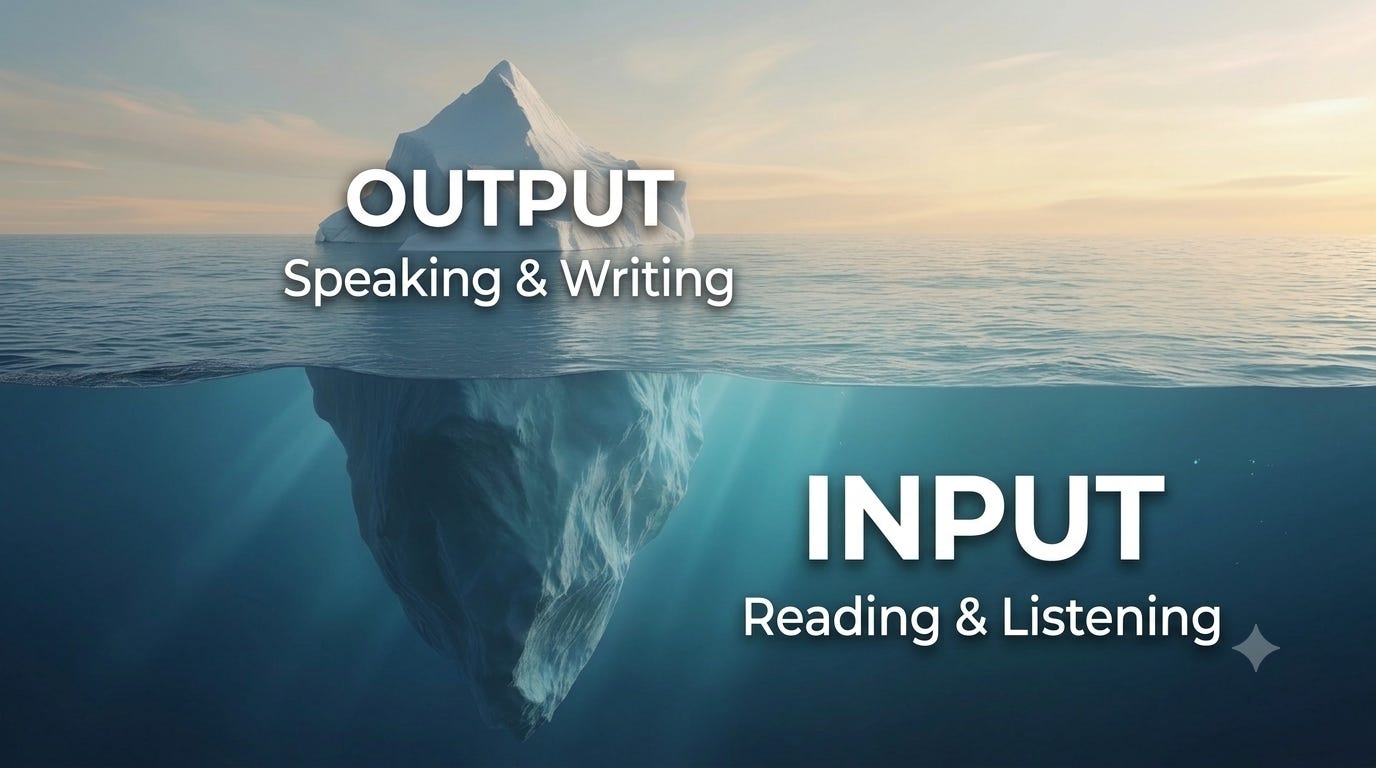
When someone hears you speak English, they hear the part above the water. The words you chose. The sentences you constructed. The accent and rhythm and vocabulary that came out of your mouth in real time.
What they don’t see is the enormous mass sitting below the surface that made it possible.
The thousands of hours of listening. The articles and books and transcripts that passed through your eyes. The vocabulary absorbed in context. The grammar patterns extracted subconsciously from millions of correctly formed sentences. The feel for rhythm and phrasing and register that built up quietly, invisibly, over months and years of input.
The speaking is the tip. The input is the iceberg.
Why the tip gets all the attention
Language learning, as most people understand it, is about the tip. Can you speak? Can you hold a conversation? Can you express yourself in English without hesitating too much?
These are the visible, measurable, demonstrable signs of English ability. They’re what job interviews test for. What classes focus on. What most learners use to judge their own progress.
But the tip doesn’t produce itself. It sits on top of something much larger, and the size and depth of what’s underneath is what determines how stable and how capable the tip above can be.
A small iceberg has a small tip. A vast iceberg has a substantial one. You don’t build a bigger tip by practising the tip. You build a bigger tip by building a bigger iceberg.
What the underwater portion is made of
The mass below the surface is your implicit knowledge of English. Everything your brain has absorbed from input that it can access automatically, without conscious effort or deliberate retrieval.
Every podcast episode you’ve listened to added to it. Every article you’ve read. Every show you’ve watched. Every conversation you’ve followed. Every sentence that entered your ears or eyes and was processed by your brain, even partially, even imperfectly, contributed something to the mass.
This knowledge is not stored the way studied knowledge is stored. You can’t recite it. You can’t list it. If someone asks you to explain why a particular phrase sounds right, you often can’t give a reason. You just know it sounds right. That instinct, that feel, is the iceberg at work.
It contains vocabulary you didn’t deliberately learn. Grammar patterns you were never taught. Phrases you absorbed whole without realising it. The particular rhythm of English sentences. The way native speakers hedge and soften and emphasise. The cultural context that makes a joke land or a reference resonate.
All of it sitting below the waterline. All of it invisible. All of it essential.
The problem with trying to build the tip directly
Most English courses focus almost entirely on the tip of the iceburg. Grammar drills. Speaking exercises. Vocabulary lists. Output practice from the very beginning.
The thinking is logical enough. You want to speak better, so you practise speaking. You want to use better vocabulary, so you memorise vocabulary. You want better grammar, so you study grammar rules.
The problem is that the tip can only be as large as the iceberg beneath it. You can't build a solid, expansive tip without the mass underneath. The tip is a product of the iceberg, not the other way around. Practising the tip without building the iceberg produces something that looks like progress for a while and then plateaus badly, because there’s nothing underneath it to draw on.
This is why so many learners study for years and still can’t speak fluently. They’ve been polishing the tip. They haven’t been building the iceberg. The foundation was never laid, so the tip has no depth to draw from.
It’s like trying to grow a tree by focusing on the branches. The branches come from the roots. Tend the roots and the branches grow naturally. Ignore the roots and no amount of attention to the branches will produce a healthy tree.
How the iceberg generates the tip
When the iceberg is deep and wide enough, something happens that surprises many learners. The speaking starts to come on its own.
Not perfectly. Not without effort. But naturally. Words arrive that the learner didn’t know they had. Phrases surface that they absorbed without knowing they were absorbing. Sentences construct themselves with a fluency that conscious grammar study never produced.
This is the iceberg doing its work. The implicit knowledge, built through months and years of input, starts expressing itself through output. The reservoir has filled enough that it overflows into production.
And the quality of that output is different from output produced through studied knowledge. It’s faster. More natural. Less monitored. It doesn’t require the painful pause while the learner searches for the rule that governs this particular construction. The rule was never learned. The pattern was absorbed. The difference in speed and fluency is enormous.
The listening-speaking ratio that most learners get wrong
Research on successful language learners and on language acquisition more broadly consistently points to the same thing. The amount of input in someone’s language learning background is the strongest predictor of how fluent they eventually become.
Steve Kaufmann, who has learned over twenty languages, estimates that he spends roughly eighty to ninety percent of his language learning time on input. Reading. Listening. Building the iceberg. The speaking practice, when it comes, sits on top of a foundation so solid that it develops quickly.
Most classroom learners have this ratio roughly inverted. More time on grammar, output, and speaking practice than on reading and listening. More time on the tip than the iceberg. And the results reflect it.
The learner who spends a year doing almost nothing but reading and listening to compelling English content, who builds a deep, wide iceberg of implicit knowledge, will often speak more naturally in their first real conversation than a learner who has spent that same year doing speaking exercises. Because the first learner has something to draw from. The second learner has been trying to build the structure without laying the foundation.
The iceberg keeps growing
One of the most encouraging aspects of this model is that the iceberg never stops growing as long as input continues.
At the intermediate level, when the tip seems to plateau and progress feels invisible, the iceberg is still expanding. Vocabulary is still being encoded. Patterns are still being refined. The implicit knowledge is still deepening. The plateau isn’t a stall. It’s the iceberg growing in ways that haven’t yet surfaced into the visible tip.
This is why the input method requires patience but rewards it so generously. The growth is happening below the waterline. The tip catches up eventually. And when it does, the improvement often feels sudden, even though it was being built steadily all along.
The tip needs some attention too
The iceberg analogy doesn't mean output is irrelevant. It means output grows from what's underneath it.
Once the iceberg is substantial enough, speaking and writing practice does real work. They activate the passive knowledge stored below the surface. They reveal which parts of the iceberg are solid and which are still forming. They build the specific skills of real-time production and retrieval that input alone doesn’t fully develop.
Glossika is useful here. Sentence repetition that trains your mouth to produce patterns your ear already knows. It builds the connection between the underwater knowledge and the above-water output, speeding up the process of converting implicit knowledge into fluent speech.
And real conversation, on iTalki or anywhere else, is the ultimate test of the iceberg’s depth. The conversation draws on everything stored below the waterline. The more that’s there, the better the conversation goes. If you’d like to test what your iceberg is made of with someone who creates a warm, low-pressure space for it, you can find me there.
But the foundation comes first. Always. Build the iceberg. The tip will follow.
What this means for how you spend your time
If you’re spending more time on grammar study, speaking practice, and vocabulary drilling than on reading and listening to real English content, your ratio is probably backwards.
Not because those things have no value. Because they’re tip work. And tip work without iceberg work produces a small, shallow, unstable structure.
Flip the ratio. Spend the majority of your English time on input. Reading on LingQ. Listening to podcasts. Watching shows. Absorbing real English through content you find interesting. Build the mass below the waterline.
And trust that the tip will grow. Not because you practised it. Because you fed what it grows from.
Where does your English feel more solid, the tip or the iceberg? Do you think your input hours match your speaking confidence? I’d love to hear where you feel the gap.
If this post helped, a like lets me know and a restack helps it reach another learner who might need it.
Tools mentioned in this article:
LingQ — build the iceberg through reading and listening to any English content with instant word lookup
Glossika (British English) or Glossika (American English) — connect the underwater knowledge to above-water production through sentence repetition
iTalki — test what your iceberg is made of in real conversation (or book directly with me)
Thanks for reading. I’m Richard, a New Zealand-based English fluency coach. I help learners build fluency through input, real conversation, and trusting the process.
Some links in this blog are affiliate links. I earn a small commission if you sign up, at no extra cost to you. I recommend these products because I believe in them.