

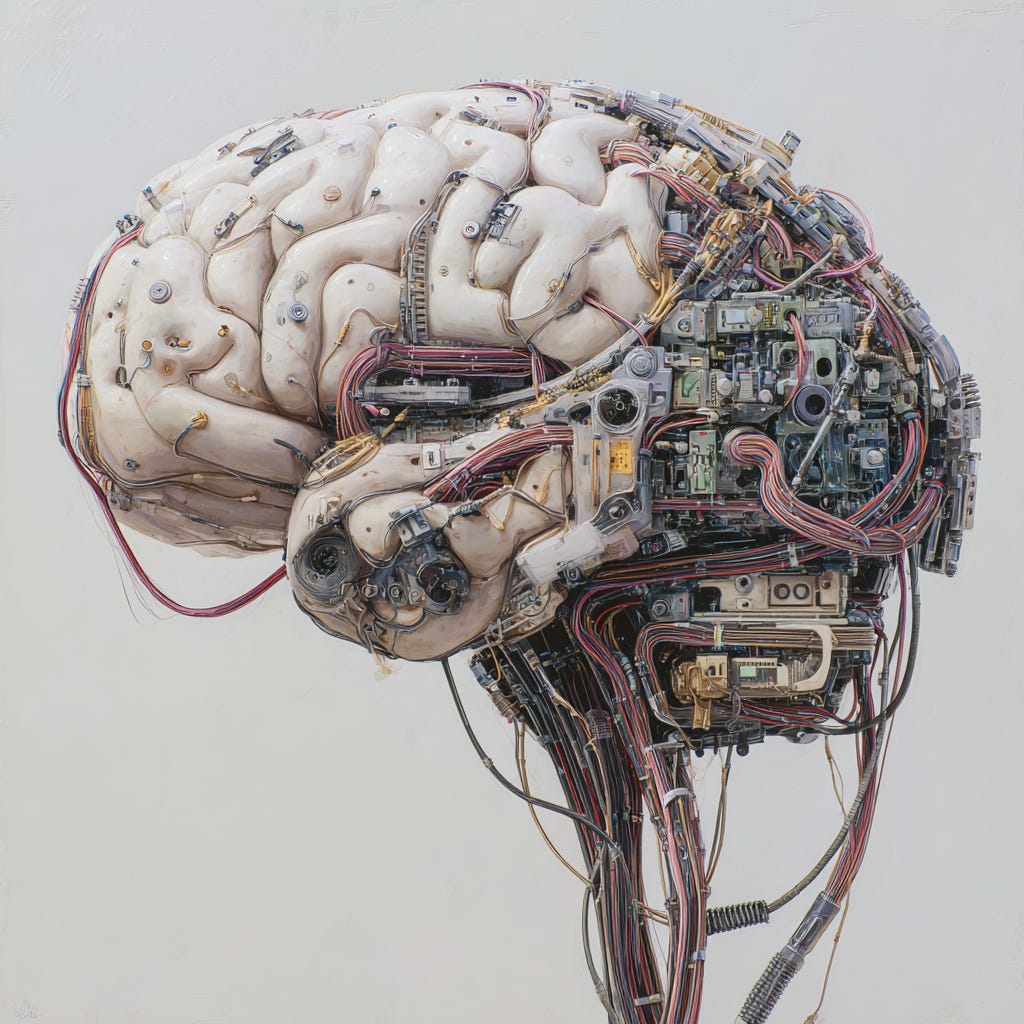
There is something almost miraculous happening inside your head right now, and you don’t have to do anything to make it work.
Your brain is, at this very moment, running one of the most sophisticated pattern-recognition systems known to exist anywhere in the universe. It is constantly searching for structure, meaning, and predictability in the information flowing into it. It is doing this whether you ask it to or not. It is extraordinarily good at it. And it is the single most important asset you have as a language learner.
The most important thing you can do to learn English is not to teach yourself English. It is to feed your brain enough real English that it can teach itself.
This sounds passive. It is not. It is the most active and intelligent thing you can do. Because your brain, given the right raw materials, will build a working model of English that no amount of conscious effort could ever construct. Your job is to supply the materials. Its job is to do what it was built to do.
The Brain as Pattern Detector
Let’s start with what we actually know about how the brain processes information, because this is not vague mysticism. It is one of the most well established findings in cognitive neuroscience.
The human brain is, fundamentally, a prediction machine. Neuroscientist Karl Friston, whose work on the free energy principle has reshaped how we understand brain function, describes the brain as constantly generating predictions about the world and updating those predictions based on incoming sensory information. Every moment, your brain is asking itself: what is going to happen next? What does this sound mean? What pattern am I seeing? And then it is checking those predictions against reality and refining its internal models to do better next time.
This process is happening continuously, automatically, and largely beneath conscious awareness. It is not something you have to instruct your brain to do. It is what your brain is.
When you apply this prediction machine to language, something remarkable happens. The brain begins to extract the statistical regularities of the language it is exposed to. Which sounds tend to follow which other sounds. Which words tend to appear together. How sentences tend to be structured. Where stress tends to fall. How meaning tends to map to form. All of this gets absorbed, not as explicit knowledge but as a deep statistical model of how the language works, built from countless observations of the language in use.
This is not a metaphor. This is what is literally happening in your auditory cortex, your temporal lobes, your language processing networks every single time you engage with English.
What the Research Actually Shows
The science here is rich and worth diving into, because it gives you reasons to trust the process that go beyond intuition.
Patricia Kuhl, a neuroscientist at the University of Washington whose research on language acquisition I have referenced before, has demonstrated through extensive brain imaging studies that infants exposed to a language begin tuning their auditory systems to that language’s sound patterns within the first months of life. They are not being taught. They are not consciously studying. They are simply being exposed to the language, and their brains are extracting its structure automatically.
What is particularly important for adult learners is that this kind of statistical learning does not end in childhood. Research by Jenny Saffran and her colleagues, including landmark studies from the 1990s, has shown that adults are just as capable as children of extracting statistical patterns from language input. Adults can identify word boundaries in a stream of speech they have never heard before based on statistical regularities alone, after only a few minutes of exposure. The mechanism is there. It is powerful. It works just as well in your thirty year old brain as it did in your three year old brain.
Morten Christiansen, a psycholinguist at Cornell University, has spent decades studying how the brain processes language as a series of patterns and chunks rather than as a system of explicit rules. His “now or never bottleneck” theory argues that the brain processes language by rapidly chunking incoming information into meaningful patterns before the next wave of information arrives. This chunking is happening hundreds of times per second, automatically, in any conversation you engage in. It is not something you do consciously. It is something your brain does because that is how it works.
The implication of all of this is profound. The pattern recognition capacity you need to acquire English is not something you have to develop. It is already there, fully functional, waiting to be deployed. You just need to give it something to work on.
The Difference Between Rules and Patterns
Here is a distinction worth being clear about, because it sits at the heart of everything we’re discussing.
Rules are explicit statements about how a system works. They are formulated in language. They can be stated, taught, and consciously applied. The English present perfect is formed with “have” or “has” plus the past participle. That is a rule. You can read it, understand it, and try to apply it.
Patterns are statistical regularities extracted from observation. They are not formulated in language. They exist as networks of associations and predictions in the brain. They cannot be stated explicitly because they don’t live in the conscious mind. They are felt rather than known. “It sounds right” is a pattern. “It feels wrong” is a pattern. The thousands of micro-judgements that go into producing a natural sounding English sentence are all patterns.
Fluent language use runs on patterns, not rules. This is not a hypothesis. It is a well established finding in psycholinguistics, supported by decades of research on how native speakers actually process and produce language. The rules that a grammar book describes are post-hoc descriptions of patterns that emerged in the language through use. They are useful for analysing language. They are not how the brain produces it.
When you study a grammar rule, you are loading explicit knowledge into your conscious mind. When you read or listen to real English, you are feeding raw data into the pattern recognition system that actually produces fluent speech. These are two completely different processes, with completely different effects on your eventual ability to use English naturally.
The brain doesn’t want rules. It wants patterns. And patterns can only be extracted from real, contextualised, meaningful use of the language. From the data, not the description of the data.
Why Real English Matters So Much
If your brain is going to extract patterns from English input, the quality and authenticity of that input matters enormously.
Real English, the kind found in articles, books, podcasts, conversations, films, and any other natural use of the language, is full of the rich statistical regularities your brain needs to build an accurate model. The way words actually combine. The way sentences actually flow. The way ideas actually connect. The way pronunciation actually works in connected speech. All of this is encoded in real English in a way that no textbook or simplified learning material can fully replicate.
When you expose your brain to real English, you are giving it the full picture. The patterns it extracts will be the patterns that actually exist in the language as it is used. The model it builds will be accurate, flexible, and useful in real communication.
When you expose your brain to artificial English, the carefully constructed dialogues of a textbook, the simplified speech of some learning materials, the limited and repetitive language of grammar exercises, you are giving it an impoverished signal. The patterns it extracts will be the patterns of that simplified material, which may not match the patterns of real English very well at all. The model it builds will be limited and brittle, and you will discover its limitations the moment you encounter real English in the wild.
This is why the input philosophy we have built throughout this blog matters so deeply. It is not just that real English is more interesting, though it is. It is that real English is the only signal rich enough to build a real model of the language. Your pattern recognition system needs real data. Give it anything less and it will build a smaller, less accurate model than it is capable of.
The Subconscious Nature of Pattern Learning
One of the most extraordinary things about your brain’s pattern recognition capacity is that it operates almost entirely below conscious awareness.
You do not have to try to extract patterns from English input. You cannot, really, even if you wanted to. The process is happening automatically in neural systems that you have no direct conscious access to. Every podcast you listen to, every article you read, every conversation you have, is feeding the system, and the system is doing its work whether you are paying attention to that work or not.
This has a profound practical implication. The amount of mental effort you are consciously expending while learning English has very little to do with how much pattern learning is actually happening. A learner who is straining to consciously analyse every sentence is not learning faster than a learner who is relaxed and absorbed in content they enjoy. They are probably learning slower, because the conscious analysis is interfering with the natural flow of the pattern extraction process.
This is what Krashen called acquisition, as opposed to learning. It is what Rod Ellis called implicit knowledge. It is what cognitive neuroscience calls statistical learning. Different fields, different terms, same underlying reality: the deep, automatic, pattern-based knowledge of a language that produces fluent speech is built through exposure, not through effort.
Your job is not to work harder. Your job is to expose yourself to more real English, more consistently, in conditions that allow your pattern recognition system to do what it does best. Conscious study is not what produces fluency. The brain produces fluency. You just need to feed it.
The Trust Problem
This is where many adult learners get stuck, and it is worth addressing directly.
It is genuinely hard to trust a process you cannot see. The brain does its pattern extraction work invisibly. You do not feel it happening. You do not get a notification when a new pattern has been internalised. The progress is real but it is not perceptible in the moment, and this creates a constant temptation to abandon the slow, quiet work of input in favour of methods that feel more active and measurable.
Grammar study feels active. You can see the rule you have learned. You can complete the exercise. You can get a score. It feels like progress, even when it is largely failing to build the kind of deep pattern knowledge that produces fluency. The visibility of the effort masks the limited nature of the result.
Input-based learning is the opposite. The effort can feel minimal, just listening to an enjoyable podcast, just reading a good article, but the result building underneath is enormous. The pattern recognition system is doing real work the whole time. You just cannot see it.
Trusting the process means being willing to do the right work even when it does not feel like work. To put in the hours of input even when nothing dramatic seems to be happening in the moment. To resist the pull toward more visibly effortful methods that feel productive but are actually less effective. To have faith in the supercomputer in your head and the patterns it is silently constructing.
This trust is not blind. It is informed by everything we know about how the brain actually acquires language. But it does require a certain willingness to let go of the need to feel each step of progress, and to instead measure your progress over months and years rather than minutes and hours.
The brain is working. You can trust that. Even when you cannot feel it.
What This Means in Practice
If you accept the basic claim of this post, that your brain is a pattern recognition supercomputer that needs only real English input to do its work, certain practical conclusions follow.
You should be spending the vast majority of your English learning time on real input. Reading and listening to content created by and for native speakers, on topics you genuinely care about. Volume matters. Variety matters. Consistency matters. Effort, in the conscious sense, matters relatively little.
You should worry less about understanding everything and more about staying engaged for as long as possible. As we have explored in our post on being okay with ambiguity, your pattern recognition system is happy to work on partial signals. It does not need perfect comprehension to extract structure. It needs enough comprehension to keep going and enough volume to build up a real statistical picture.
You should avoid methods that interfere with the natural flow of pattern extraction. This includes most explicit grammar study, which loads your conscious mind with rules that interfere with the implicit pattern matching your brain wants to do. It includes most flashcard-based vocabulary study, which strips words from the context that allows your brain to build rich associative networks around them. It includes any method that prioritises conscious effort over natural exposure.
You should give the process time. The brain is fast, but it needs hundreds and thousands of hours of input to build a fluent model of a complex language. There is no shortcut. There is no hack. There is only the steady accumulation of exposure, day after day, week after week, year after year, while the supercomputer in your head does its quiet work.
The Wonder of It
It is worth pausing for a moment to appreciate what is actually being claimed here.
You have, inside your skull, a piece of biological machinery capable of acquiring a language to native-like fluency, without instruction, simply through sufficient exposure to that language in use. This machinery is more sophisticated than any artificial intelligence system humans have ever built. It is more capable than any language learning method ever designed. It is more powerful than any tool you could buy or course you could take.
And it is yours. For free. Right now. Working away whether you ask it to or not.
The only thing that determines how good your English becomes is whether you give this machinery enough of the right kind of fuel to do its work. Real English. In sufficient volume. Over sufficient time. With sufficient consistency.
You do not need to be smarter. You do not need to be more disciplined. You do not need to find the perfect method. You just need to feed your brain real English, regularly, for long enough.
It will do the rest.
How to Feed Your Brain
The most practical way to feed your brain the real English it needs is also one of the most enjoyable. Read content you love. Listen to content you love. Combine reading and listening together whenever possible to maximise the depth and richness of the input.
LingQ is built around exactly this approach. It lets you import any English content you find genuinely interesting, read and listen to it simultaneously, look up words in context without breaking the flow, and track every word you encounter as you go. It is essentially a tool for feeding your brain real English in the most efficient, enjoyable, and trackable way possible. Sign up here: lingq.com
Build the Network
For weaving the richest possible network of English connections through reading, listening, and vocabulary tracking, LingQ is the tool I recommend above all others: lingq.com
For adding visual and emotional connections to your network through TV shows and films with interactive subtitles, Lingopie turns your screen time into genuine acquisition.
If you want compelling, story-driven English listening at just the right level, Olly Richards’ Conversations course is well worth exploring.
If you’re looking for a conversation partner to practise your English with, iTalki is where I’d start. And if you’d like to work with me specifically, book a trial lesson here.
✍🏼 Richard
Some links on this blog are affiliate links. I earn a small commission if you sign up, at no cost to you. I recommend these products because I genuinely believe in them.