

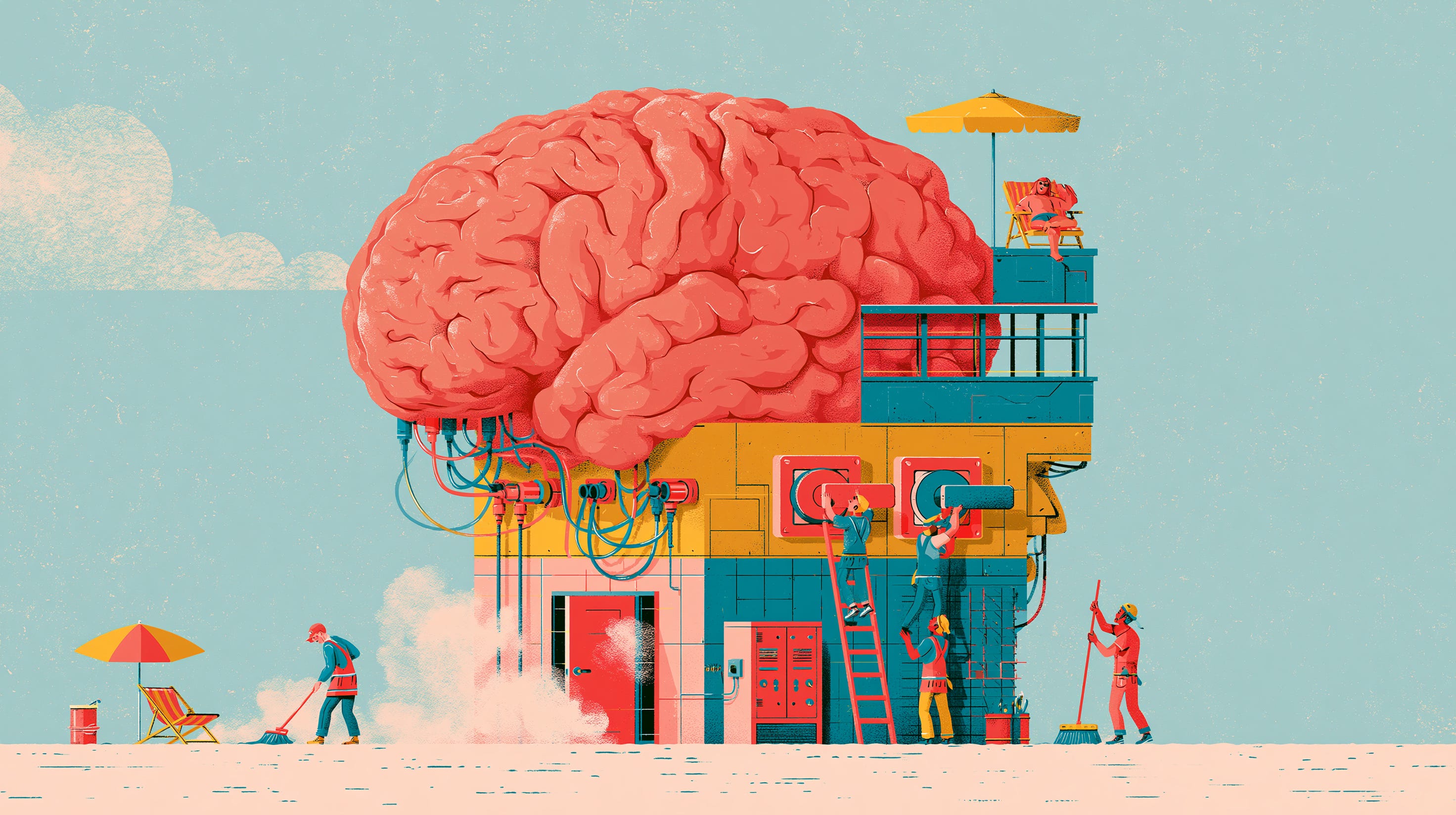
We talk about what to read, what to listen to, how to structure your practice, which tools to use, how to find a conversation partner. But we rarely talk about the fact that all of this costs your brain energy, and that energy is not unlimited.
Learning a second language is one of the most cognitively demanding things a person can do. Research consistently shows that it engages memory, attention, and executive functioning simultaneously, more brain systems working at once than most daily activities require. Your brain is processing unfamiliar sounds, mapping new words to meanings, extracting grammar patterns, monitoring comprehension, and trying to keep up with input that moves faster than your processing speed.
Even when it doesn’t feel like hard work, even when you’re enjoying a podcast or reading something you find interesting, the brain is running hotter than it would be doing the same activity in your native language. The enjoyment is real. The cognitive load is also real. Both are happening at the same time.
What fatigue feels like
You probably know this feeling, even if you’ve never named it.
You’ve been listening to English for forty minutes and suddenly you realise you haven’t followed the last five. Your mind drifted. Not because the content was boring. Because your brain quietly ran out of processing fuel and stopped keeping up without telling you.
Or you’re reading an article and the same sentence has passed under your eyes three times without landing. The words are there. The meaning isn’t forming. The engine has stalled.
Or you finish a conversation session and feel disproportionately tired. You only talked for thirty minutes but it feels like you ran a race. Your native language conversations don’t leave you like this. English conversations do, because every sentence requires more processing than the equivalent in your first language. Students I work with on iTalki notice this more than almost anything else.
This is cognitive fatigue. It’s not a sign that something is wrong. It’s a sign that your brain has been working hard and needs a break. The same way your muscles need rest after exercise, your cognitive systems need rest after sustained second language processing.
The load is real even when it’s fun
This is worth emphasising because the input method is built around enjoyment, and there’s a risk of assuming that enjoyable practice doesn’t tire you out.
It does. Less than grinding through grammar drills, certainly. Less than forcing yourself through content you find boring. But the processing load of operating in a second language is there regardless of whether the content is enjoyable. You’re still decoding unfamiliar sounds. You’re still encountering words your brain has to work to retrieve or infer. You’re still running the whole acquisition system at a level above its resting state.
A runner who loves running still gets tired. A reader who loves reading in a second language still reaches a point where the brain says enough for now. Respecting that point, rather than pushing through it out of discipline, is part of using the method well.
Why pushing through doesn’t help
The instinct when fatigue sets in is to push harder. Keep listening. Keep reading. Force the concentration. After all, more input means more acquisition, right?
Not when the brain has checked out. Input that washes over a fatigued brain is not being processed the way input washes over a fresh one. The pattern recognition is sluggish. The vocabulary encoding is shallow. The comprehension is surface level at best. You’re physically present with the English but cognitively absent from it.
The session that happens after fatigue has set in is worth a fraction of the session that happened before it. Continuing to push doesn’t double the benefit. It dilutes it. And worse, it can start to associate English with the unpleasant feeling of mental exhaustion, which quietly undermines the enjoyment that makes the method sustainable.
The surprising upside of fatigue
Here’s something genuinely interesting from the research. A 2026 study published in Cognitive Science found that cognitive fatigue actually enhanced a particular kind of language learning: statistical learning, the brain’s ability to detect repeating patterns in speech.
The researchers suggested that when the brain’s conscious control systems are fatigued, the implicit learning system, the one that operates below awareness and is responsible for pattern extraction, gets more room to work. The tired brain stops overthinking and starts absorbing.
This doesn’t mean you should exhaust yourself on purpose. But it does suggest that the feeling of being slightly tired during input isn’t necessarily a sign that nothing is happening. Your conscious processing might be fading, but the deeper, implicit system may still be running, quietly extracting patterns from whatever English is flowing past.
The practical takeaway: don’t panic when fatigue arrives. The acquisition may still be ticking over at a level you can’t feel. But do respect the signal. When the fatigue is genuine, rest.
Rest is part of the method
Rest isn’t the absence of learning. It’s a phase of learning.
During rest, and especially during sleep, your brain consolidates what it absorbed during the active phase. It replays the input. It strengthens connections. It moves fragile, temporary traces into more durable long term storage. The vocabulary you encountered this morning is being processed tonight. The grammar patterns are being refined while you sleep.
A learner who does forty five minutes of focused, enjoyable English input and then rests is getting more out of that forty five minutes than a learner who does ninety minutes and pushes through the fatigue for the last forty five. The first learner’s brain has fresh, deeply processed input to consolidate. The second learner’s brain has forty five minutes of good input and forty five minutes of diminished input competing for the same consolidation resources.
More is not always more. Better is more.
Practical strategies for managing the load
Know your window. Most people have a cognitive peak, a time of day when their brain is freshest and most capable of sustained processing. For many people that’s the morning. For others it’s the evening. Do your most demanding English practice, the reading that stretches you, the content that’s slightly above your level, during your peak. Save the easier, more passive input for when you’re naturally lower on energy.
Vary the intensity. Not every session needs to be at full stretch. Alternate between challenging content and comfortable content. A demanding article on LingQ in the morning. An easy, familiar podcast on the commute. A show you’ve seen before on Lingopie in the evening. The variation keeps the brain engaged without running it at maximum all day.
Stop before you’re empty. End sessions while you’re still engaged rather than when you’ve hit the wall. This keeps the experience positive, protects the association between English and enjoyment, and leaves the brain with energy for consolidation.
Nap if you can. A nap after an input session gives the brain consolidation time in the middle of the day. Even twenty minutes can reduce the cognitive fatigue that impairs subsequent learning. A morning reading session followed by a lunchtime nap is a surprisingly effective combination.
Take days off. Not every day needs to be an English day. A day without any English input is not a day lost. It’s a day of consolidation, of rest, of letting the brain catch up with everything you’ve been feeding it. The learners who sustain this for years are the ones who give themselves permission to take a day off without guilt.
Switch to your native language when you need to. There’s no rule that says every waking minute needs to be in English. When your brain is tired, switching back to your native language for a while isn’t giving up. It’s managing your resources intelligently so that the next English session is productive rather than depleted.
The rhythm that works
The best English practice routine has a rhythm to it. Periods of input. Periods of rest. Harder sessions followed by easier ones. Active days followed by lighter ones. Weeks of consistent practice followed by occasional breaks.
This rhythm mirrors how the body responds to physical training. Athletes don’t train at maximum intensity every day. They alternate hard sessions with recovery. They take rest days. They periodise their training across weeks and months. The rest is built into the programme because the gains happen during recovery, not during the session itself.
Your English practice works the same way. The gains happen during the consolidation, not during the input. The input provides the raw material. The rest processes it. Both are necessary. Neither works without the other.
Listen to your brain the way an athlete listens to their body. When it’s fresh, push a little. When it’s tired, ease off. When it’s exhausted, stop.
The English will still be there tomorrow. And tomorrow’s brain will be better rested, better consolidated, and better prepared to make the most of it.
Got a question about your English learning? Drop it in the comments and it might become a future post.
If this post helped, a like lets me know and a restack helps it reach another learner who might need it.
Thanks for reading. I’m Richard, an English fluency coach based in New Zealand. I help learners build fluency through input, real conversation, and knowing when to rest.
Some links in this blog are affiliate links. I earn a small commission if you sign up, at no extra cost to you. I recommend these products because I believe in them.