

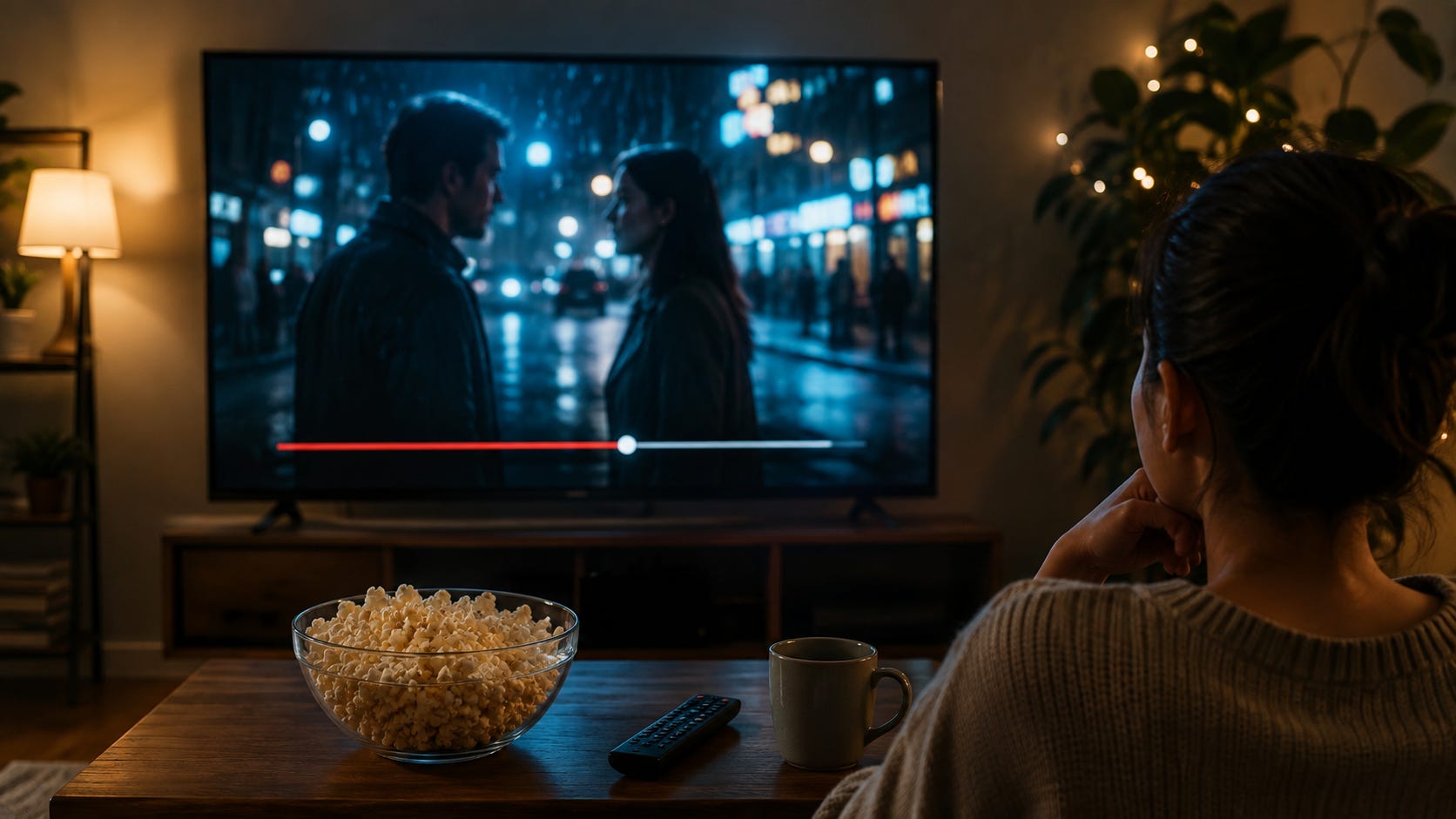
A lot of learners tell me some version of the same thing. Their English is actually pretty strong. They follow podcasts comfortably. They can hold a real conversation with another person. Audiobooks are no problem. And then they sit down to watch a movie or a television series and suddenly feel like they have gone backwards, catching maybe half of what is actually being said.
That experience is completely real, not some personal failing in your listening.
Why film and television are genuinely harder
A podcast is usually one or two people, recorded close to a microphone, in a quiet room, speaking with the specific goal of being heard clearly. A conversation with a real person gives you a face to read, body language, context, and the ability to ask them to repeat something.
A film gives you almost none of that. Dialogue is mixed alongside music, sound effects, and background noise, often deliberately, because a film is built for atmosphere and emotion, not for clarity of speech. Actors frequently speak quickly, quietly, or with heavy regional accents, because realism matters more to a director than making sure every word reaches a language learner clearly. Characters talk over each other. Important lines get delivered in a whisper during a tense scene, precisely when the music is swelling behind them.
This is not a small handicap. It is a genuinely difficult listening environment, arguably one of the hardest a learner can attempt.
Even native speakers struggle with this
Here is something that might surprise you. I am a native English speaker, and there are shows where I cannot catch everything that is said either. Certain films, certain actors, certain sound mixes are difficult even for someone who has spoken English their entire life. I have put subtitles on for English language shows more times than I can count, simply because the audio was too muddy or the accents too thick to follow without help.
If a native speaker sometimes needs subtitles to follow English content, a learner struggling with the same content is not behind. You are running into a genuinely difficult listening task, one that trips up plenty of first language speakers too.
Why this matters for how you think about your progress
A lot of learners quietly conclude that their listening must be weaker than they thought the moment a movie defeats them. That conclusion is usually wrong. Podcast comprehension and film comprehension are testing different things. A podcast tests your ability to follow clear, deliberate speech. A film tests your ability to extract meaning from noisy, fast, unclear speech layered with music and effects, which is a genuinely different and harder skill.
Struggling with film and television, while doing well everywhere else, is not a sign your English has a hole in it. It is a sign you are facing one of the last and hardest frontiers of listening comprehension, the one even native speakers do not always clear without help.
How to actually build this skill
The good news is that this particular skill responds well to deliberate practice, the same way any hard listening task does.
Subtitles are not cheating. Use English subtitles freely, especially at first, and let them close the gap between what you hear and what is actually being said. Over time, as your ear catches up, you can rely on them less. A platform like Lingopie is built specifically for this, pairing real shows with subtitles designed to help the language actually land rather than just flashing past.
Rewatch things. A second viewing of a scene you struggled with the first time often reveals lines you completely missed, because you already know roughly what happens and your brain has more room to focus on the actual words rather than just following the plot.
Pick genres and shows with clearer dialogue when you are building this skill. Some films are notoriously difficult even for native speakers, all mumbled dialogue and dense accents. Starting with shows that prioritise clear dialogue, then working toward harder material, builds the skill gradually instead of throwing you into the hardest end of it immediately.
And be patient with this specific frontier. It genuinely takes longer to develop than conversational listening, precisely because the listening conditions are so much harder. Progress here tends to arrive more slowly and less visibly than progress in other areas, which makes it easy to feel discouraged if you are comparing it to how quickly your podcast comprehension improved.
A normal part of the process
If movies and television still feel like the hardest part of your English, you are not missing something everyone else has figured out. You are facing a challenge that is objectively difficult, one that even fluent native speakers sometimes need help with.
Keep watching. Keep the subtitles on for as long as you need them. The gap closes slowly, and it does close.
If you have a question about your English, something you have been stuck on or curious about, let me know in the comments. I read every one, and I might turn your question into a future post.
Richard, English fluency coach in Auckland, New Zealand, who still occasionally reaches for subtitles himself.
Tools I recommend:
LingQ — read and listen to real content with instant word lookup and automatic vocabulary tracking
Lingopie — real TV shows and films with interactive subtitles
Glossika — structured sentence repetition to build speaking fluency, available in both British and American English
StoryLearning — compelling, story driven listening practice at just the right level
iTalki — find a teacher for real conversation practice, or book a session directly with me
Some links in this blog are affiliate links. I earn a small commission if you sign up, at no extra cost to you. I recommend these products because I believe in them.