

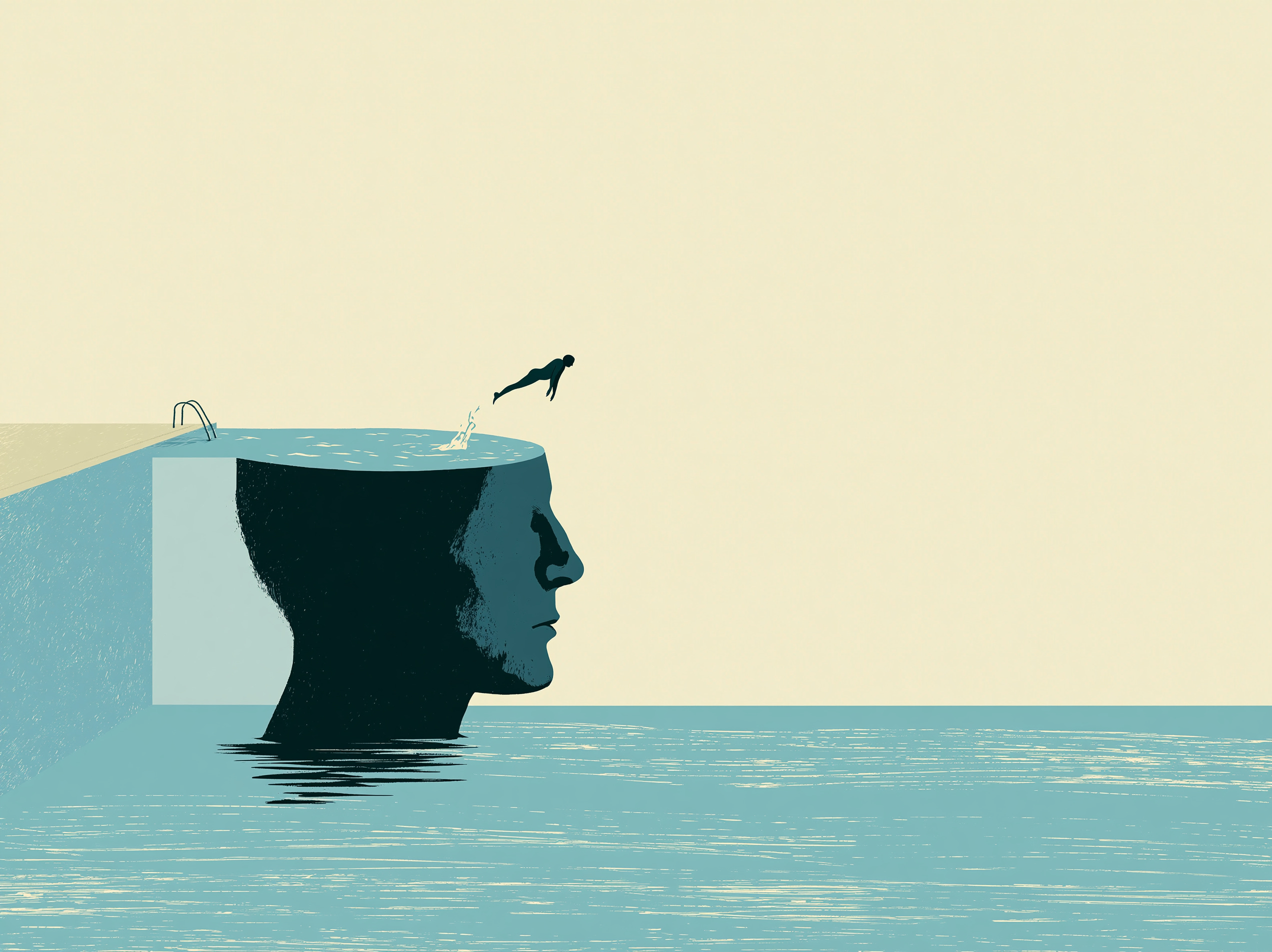
I can spot a grammar-damaged student within thirty seconds of a session starting. Not from their level. Not from their accent. From the pause.
Mid-sentence. Eyes drift upward. The jaw tightens slightly. They were telling me about their weekend, the words were coming, and then everything stops. Behind their face, I can see the filing cabinet being rifled through. Should that be past simple or present perfect? Do I need an article here? Is “since” right or should it be “for”?
By the time they’ve settled on an answer, the thought is gone. The conversational moment has passed. The sentence that eventually comes out is stiff, careful, and sounds nothing like how they’d express the same idea in their native language.
This happens constantly. With students from every country, every background, every level. The pattern is identical because the cause is identical: years of English instruction that treated every mistake as a failure and installed an internal checkpoint between brain and mouth.
The Checkpoint
The checkpoint is a monitoring system. It sits between your thoughts and your speech and inspects every sentence before allowing it through. Is the tense correct? Is the preposition right? Does this word agree with that one?
The checkpoint was built by thousands of classroom corrections. Red pen on papers. Points deducted on tests. A teacher’s correction in front of thirty peers. The implicit message, absorbed over years: errors are bad. Correctness is the price of participation. If you speak, you must speak correctly.
The checkpoint was supposed to improve your accuracy. What it actually does is strangle your fluency. Because the checkpoint operates on conscious grammar knowledge, which is slow, and conversation operates at a speed that conscious processing cannot match. The checkpoint tries to do at walking pace what needs to happen at motorway speed. The result is hesitation, self-correction spirals, and the retreat to simple sentences because simple sentences are safe.
Native speakers don’t have this checkpoint. They produce grammar automatically, from their implicit system, without consulting any rules. They’ve never thought about whether to use “since” or “for.” The correct form is just there, available instantly, because they’ve encountered it tens of thousands of times in context.
The checkpoint is not a feature of English. It’s an artefact of how you were taught.
The Symptoms
The pause. That mid-sentence freeze where the grammar inspector activates.
The spiral. “I went... no, I have gone... no, I had gone... I went?” Three attempts at the same verb, each less confident than the last.
The simplification. Retreating to “it was good” and “I like it” when you have far richer vocabulary available, because simple sentences can’t go wrong.
The pre-construction. Building the entire sentence silently before saying it. The sentence arrives grammatically careful and conversationally dead.
The apology. “Sorry, my English is not good.” From someone who just communicated a complex idea perfectly well with slightly imperfect grammar.
The belief. Underneath everything, the conviction that more grammar study would fix it. That the solution to the problem caused by grammar instruction is more grammar instruction.
Why the Checkpoint Can’t Do the Job
The checkpoint operates on explicit knowledge. Rules stored in conscious memory. Accessible through deliberate recall.
Fluent speech operates on implicit knowledge. Patterns absorbed through exposure. Accessible automatically at conversational speed.
These are different systems in the brain, stored differently, accessed differently. The explicit system is too slow for conversation. By the time it’s checked the tense, the moment has passed. Native speakers bypass it entirely because their implicit system handles grammar without conscious involvement.
The checkpoint is trying to do manually what the implicit system does automatically. It’s like trying to calculate the physics of balance while riding a bicycle. The calculation takes too long. The body handles balance without it. And the attempt to calculate actually interferes with the balance that the body would manage perfectly well on its own.
Building What Replaces It
The checkpoint is loud because the implicit system is underdeveloped. If you spent years studying grammar but relatively few hours reading and listening to real English, your explicit knowledge is far ahead of your implicit feel for the language. The checkpoint fills the gap.
The gap closes through input. Every article you read on LingQ feeds the implicit system with hundreds of correctly formed English sentences. The grammar is in the sentences. Your brain extracts the patterns without anyone explaining them. Over months of daily reading and listening, the implicit system strengthens. The correct forms become available automatically. And the checkpoint, finding itself increasingly redundant, gets quieter.
This is gradual. The implicit system builds slowly, across hundreds of hours. But every hour shifts the balance. The checkpoint loses a fraction of its authority. The implicit system gains a fraction of confidence. The speaking gets a fraction freer.
Speaking Without Permission
The checkpoint demands permission before it releases a sentence. The healing involves learning to speak without waiting for that permission.
Start with private production. Talking to yourself in English. Nobody listening. Nobody judging. The checkpoint is quieter when there’s no audience. Narrate your morning. Describe what you see. Argue with yourself about something you care about. Every sentence that comes out without the checkpoint’s approval is a small act of rebellion against the conditioning.
Shadow a podcast. Speaking along slightly behind a native speaker, matching their rhythm, produces English from your mouth without the checkpoint having time to intervene. The speaker’s pace pulls you forward faster than the inspector can operate.
Glossika is particularly useful here. You hear a sentence. You repeat it. The speed of the exercise gives the checkpoint no time to analyse. The production happens before the monitoring can activate. Rep after rep, you’re training your mouth to produce English that bypasses the inspector entirely.
Then, when you’re ready, a conversation with someone warm. Someone who responds to your meaning rather than policing your form. In my sessions on iTalki, I use recasting rather than correction. If you say “I go yesterday to the shop,” I respond with “oh you went to the shop? What did you get?” The correct form enters your ear without the conversation stopping. Without embarrassment. Without the checkpoint being reinforced.
Each warm conversation is a counter-experience to the years of classroom conditioning. Your nervous system gradually learns that speaking imperfect English doesn’t produce punishment. The checkpoint weakens because its entire purpose, protecting you from the consequences of errors, is shown to be unnecessary.
The Fear of Fossilisation
The deepest fear of the grammar-recovering learner: without the checkpoint, won’t my errors become permanent?
In my experience, this fear is unfounded for learners doing consistent input. The reading and listening that build your implicit system are also quietly correcting your errors. Every correctly formed sentence you encounter is a model. After hearing “I went” a thousand times across podcasts, shows, and articles, “I goed” starts to feel wrong in your mouth. The correction comes from the input, not from the checkpoint.
The input does the inspector’s job more accurately, more naturally, and without the anxiety.
What Healing Looks Like
It starts small. A sentence that comes out unplanned and unchecked. You don’t notice it. I do.
Over weeks, the pauses shorten. The spirals disappear. Whole stretches of conversation flow without the checkpoint intervening. You start telling stories. Making jokes. Disagreeing with me about something and arguing your position with spontaneity that would have been impossible three months ago.
And then a moment arrives where you say something and I ask if it was grammatically correct and you say: “I don’t know. But it sounded right.”
That’s the implicit system talking. That’s the feel for the language, built from hundreds of hours of input, operating where the checkpoint used to be. Faster. More accurate. And without the anxiety.
You were never broken. The acquisition system was always there, underneath the checkpoint, waiting to do its job. The grammar instruction built something on top of it that got in the way.
The healing is clearing the obstruction. Feeding the system. And speaking with the freedom your English always deserved.
For building the implicit system that replaces the checkpoint, through reading and listening to real English you love, LingQ is the tool I recommend above all others.
For absorbing natural English through real TV shows and films with interactive subtitles, Lingopie turns your screen time into genuine acquisition.
For bypassing the checkpoint through structured sentence repetition that moves faster than the inspector can operate, Glossika trains production without the monitoring. Available in both British and American English.
If you want compelling, story-driven English listening at just the right level, Olly Richards’ Conversations course is well worth exploring.
If you’re looking for a conversation partner who will never reinforce the checkpoint, iTalki is where I’d start. And if you’d like to work with me, book a trial lesson here.
✍🏼 Richard
Thanks for reading. I’m Richard, an English conversation partner based in New Zealand. I help learners find their voice in English through warm, natural conversation and the input method.
Some links on this blog are affiliate links. I earn a small commission if you sign up, at no cost to you. I recommend these products because I genuinely believe in them.
Thank you for your kind words.
This was fascinating to read. Thank you.
I've been looking at where I can learn to improve my grammar and writing, in general, when I could just be reading books and listening to people.
I have a reasonable ear for the flow of a sentence, but I still muddle up my tenses and regularly question myself after I've finished writing.