

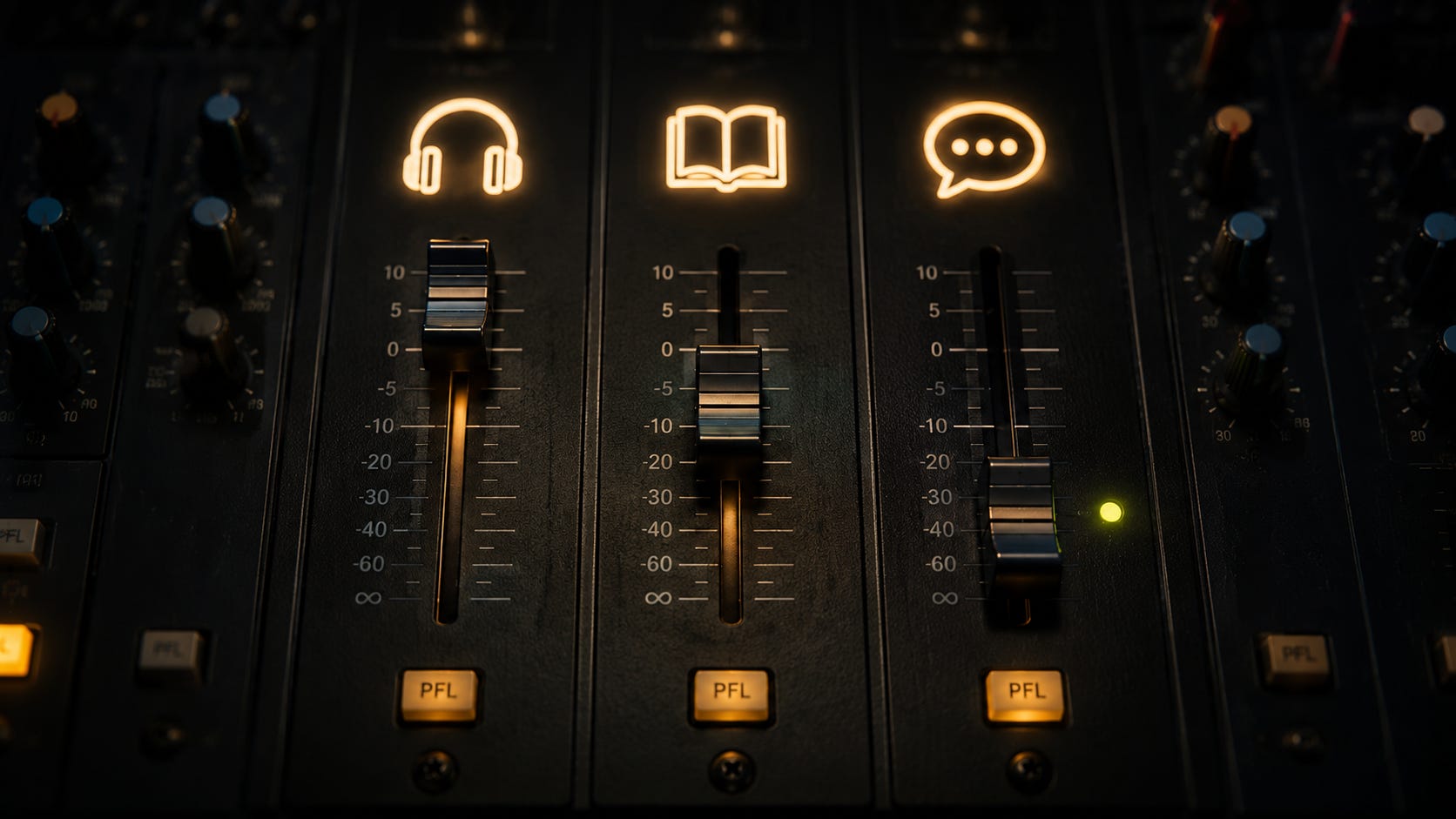
It is one of the most practical questions I get asked. I understand I need to be reading, listening, and speaking. Fine. But how much of each? Is there a ratio? A formula? Something I can actually follow?
I went looking for a clean answer in the research, partly because I wanted to check my own instincts against something more rigorous than years of watching students progress. What I found was less tidy than a formula, but genuinely useful once you understand why.
What the research actually says
There is no study that hands you a precise ratio of reading to listening to speaking and tells you to follow it. Language acquisition does not work that cleanly, and anyone selling you an exact formula is oversimplifying something the research treats with more nuance.
What the research does give you is a set of principles. Stephen Krashen’s work on optimal input describes what good input looks like, comprehensible, engaging, and delivered in large quantity, rather than specifying exactly how many hours of it you need. Other researchers have focused on the idea of comprehensible input sitting in a specific zone, somewhere around ninety to ninety eight percent understood, so that the content is accessible but still stretches you slightly. That is a principle about quality and difficulty, not a ratio between skills.
The closest thing to a ratio I found comes from practitioners rather than formal studies. The general suggestion is roughly twice as much input as output, reading and listening combined outweighing speaking and writing by a significant margin, particularly in the earlier stages. The logic is simple. You have two ears and two eyes and only one mouth, and comprehension has to come before production in any meaningful sense. You cannot produce language you have not first absorbed.
Beyond that broad principle, the literature stays quiet on precise numbers. Which means the specific ratio you use is genuinely a matter of judgement, not a fixed rule waiting to be discovered.
What I actually tell my students
Given the lack of a definitive answer, here is the guidance I give, built from watching what has worked for students over the years rather than from any single study.
If you are reading for twenty minutes, aim for at least double that in listening, and more if you can manage it. Half an hour of reading might sit alongside an hour to two hours of listening. The reason is partly practical. Listening tends to be easier to fit into an already busy life. You can listen on a commute, during chores, while exercising, in ways that reading simply does not allow. And listening builds something reading alone cannot, the rhythm, the connected speech, the natural pacing of English as it is actually spoken.
Reading still matters enormously, and I would never suggest dropping it in favour of listening alone. Reading builds vocabulary at a pace listening struggles to match, because you can pause, notice, and absorb a written word in a way that spoken language, moving at full natural speed, does not allow. But if I had to weight the two, listening earns the larger share, because it is the one that produces natural, fluent sounding English more directly than anything else.
Speaking is different again. There is no ratio for speaking that makes sense in the same way, because speaking opportunities are rarely as flexible as reading and listening. My honest advice is simply this. Speak as much as you can, whenever you can. There is no such thing as too much speaking practice, and there is no wrong amount as long as it is more than none.
Why this works the way it does
The underlying logic connects back to everything else on this blog. Comprehension has to come first, because comprehension is where the language actually gets built. You cannot produce a pattern your brain has not yet absorbed through understanding it repeatedly.
Listening, in particular, deserves the weight I give it because so much of what makes English sound natural, the stress, the rhythm, the way words blur together in casual speech, lives almost entirely in sound. A learner who reads extensively but listens rarely often develops excellent vocabulary and a strong grasp of written English, while their spoken English lags noticeably behind. The ear needs its own dedicated time to catch up.
Reading, meanwhile, gives you a depth and precision that listening alone develops more slowly, because you can sit with a sentence, notice its construction, and absorb a new word properly before moving on.
Together, they build different parts of the same overall fluency, and neither one substitutes fully for the other.
Building this into your week
If you want a rough starting point rather than a rigid rule, this is a reasonable place to begin. Some reading every day, even briefly, using something like LingQ if you want to make that reading easy to sustain without getting stuck on unfamiliar words. Roughly double that time in listening, spread across whatever pockets of your day allow for it, a podcast, a show, background listening while you do something else. And speaking whenever the opportunity presents itself, formally or informally, without worrying about hitting any particular target.
If speaking opportunities are the hardest part of your week to find, that is worth addressing directly rather than leaving to chance. You can book a session with me on iTalki and build a regular slot of real conversation into your routine, which turns speaking from something you fit in occasionally into something with a fixed place in your week.
The honest answer
There is no perfect ratio, and anyone who tells you there is one, precisely, is telling you more than the research actually knows. What exists is a set of reasonable principles. More input than output. More listening than most learners naturally give it. As much speaking as you can manage, without guilt about however much or little that turns out to be.
Follow that shape loosely, adjust it to your own life, and trust that consistency across all three matters more than getting the exact proportions right.
How do you currently split your time between reading, listening, and speaking? I’d be curious to know in the comments.
If this post helped, a like lets me know and a restack helps it reach another learner who might need it.
Written by Richard, an English fluency coach in Auckland, New Zealand, still refining his own ratios after years of trying.
Some links in this blog are affiliate links. I earn a small commission if you sign up, at no extra cost to you. I recommend these products because I believe in them.