

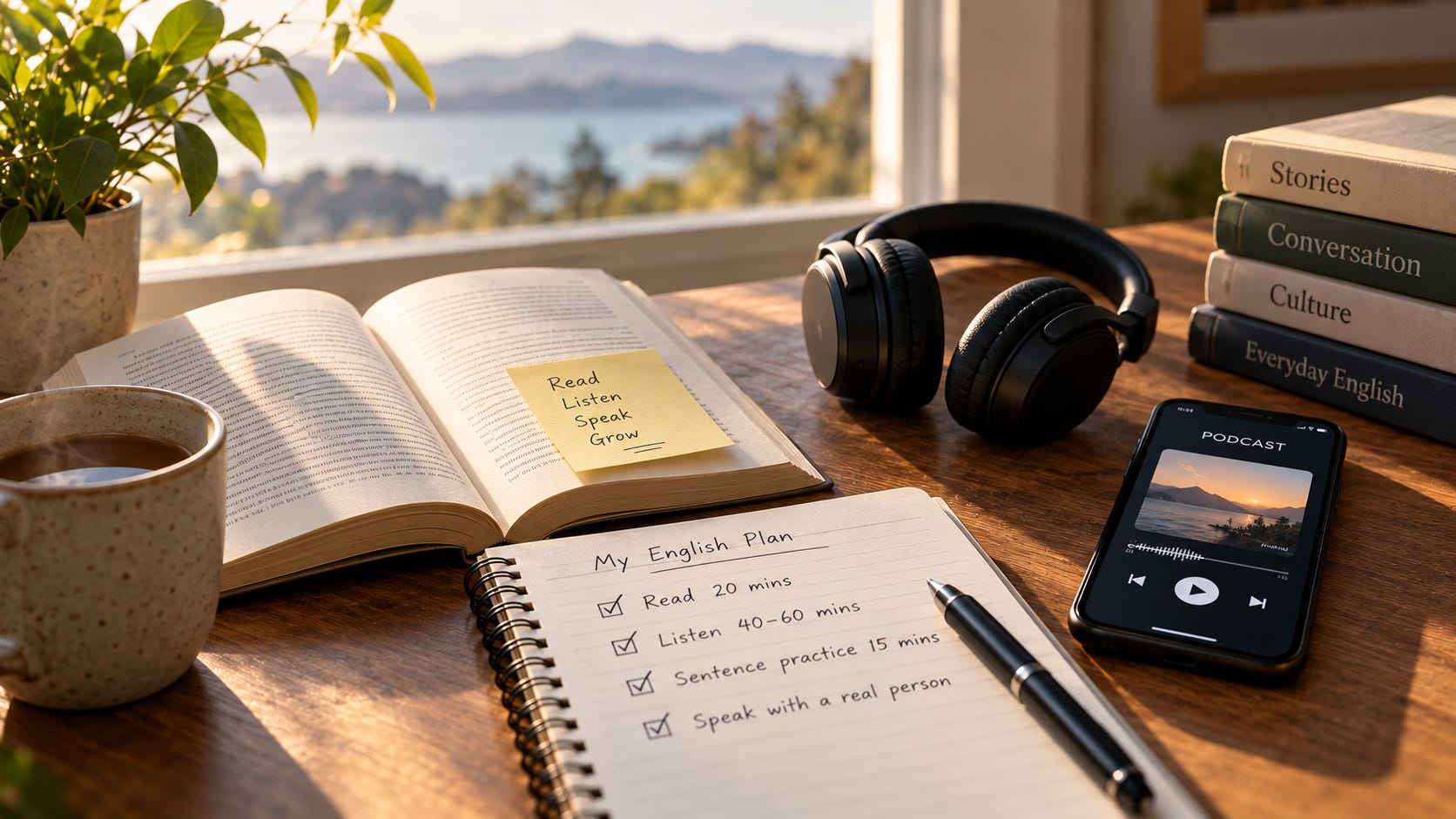
“Teacher, how do I learn English?”
It’s the question I hear most, from students and from readers of this blog. My usual answer, read and listen and trust the process, is true, but it can sound vague when you’re standing at the start of a Tuesday wondering where to begin.
This is my recommendation, drawn from my own experience learning foreign languages and from what I’ve watched work for my students over the years. Other approaches exist, and this is the one I’ve seen deliver.
Start with what you like
Figure out what you enjoy consuming, in any language. A type of story, a kind of humour, a topic you could talk about for an hour without getting bored. True crime, cooking, football, romance novels, science.
You’ll come back to content you like day after day, and the whole plan runs on that. Content chosen because it seems educational is the most common reason learners drop a good method within a few weeks.
Read a little every day
Pick one piece of English that interests you and sits at a level where you can follow most of it, even if not every word. A short article or a chapter of a book works well.
When you hit a word you don’t know, look it up quickly and keep reading. Don’t stop to study it or add it to a list. It will come back in other content, and it sticks through repetition rather than through effort in a single moment.
LingQ makes this easy, because the lookup happens inside the text, so a trip to a dictionary app never breaks your flow. Fifteen to twenty minutes most days is a good place to start.
Listen a lot
Find a podcast, YouTube channel, or show in English on something you’d want to know about even in your own language. Put it on during a commute, a walk, or a chore, any time that would otherwise be silence or music you’re not really listening to.
Aim to follow the general thread rather than every word. Some days you’ll catch more than others, which is normal. Roughly double the time you spend reading works well, so twenty minutes of reading might sit alongside forty minutes to an hour of listening across the day. It adds up fast when it’s folded into things you already do.
If you prefer watching, a series on Lingopie with interactive subtitles counts as listening. For a gentler level, StoryLearning Conversations offers story driven English listening pitched at the right difficulty.
Say sentences out loud
Reading and listening fill your head with English. Speaking is a separate skill and needs practice of its own, and Flexling is where that step fits in my plan.
Each sentence is played for you, then you speak it back, round after round, and spaced review returns the ones you find hardest. The number of rounds is up to you, so a tricky sentence can get five and a familiar one just one. Your mouth gets used to correct English, and the grammar patterns settle in without you studying rules. If a grammar point trips you up, you can ask the app for an explanation and it will build practice sentences around it.
Ten or fifteen minutes fits easily into a walk, because the shadowing mode works without looking at the screen. It’s the tool I now recommend for this step, based on my own Spanish practice. There’s a free plan if you’d like to try it first.
Speak with real people
Most learners find this the hardest part to build into a routine, because speaking needs another person. Take the chances you have, like a colleague, a language exchange, or an online community. Don’t wait until you feel ready, because that feeling usually arrives after you start speaking.
If your days don’t offer speaking opportunities, build one. A weekly session with a teacher or conversation partner turns speaking from something you hope will happen into something in your calendar. iTalki lists tutors for every style and budget, and my own profile is there too if you’d like to book a lesson with me.
Keep it sustainable
Small amounts done most days beat big bursts. Twenty minutes of reading and forty of listening most days over a year will take you further than three hours crammed into one exhausted Sunday, followed by two weeks of nothing.
Build a version that fits the life you have, not the one you wish you had time for. If you miss a day, pick it up the next. The plan has no penalty for imperfection, only for giving up entirely.
A sample day
Morning: fifteen minutes of reading with a coffee.
During the day: a podcast or show on your commute, a walk, or a chore.
Afternoon or evening: ten to fifteen minutes of sentence practice, ideally on a walk.
Once a week: a conversation with a teacher or partner.
Expect a slow start
You won’t notice much in the first few weeks. The changes show up in hindsight rather than in the moment. A show that used to feel too fast starts to feel manageable. A conversation you’d have avoided six months ago feels uncomfortable instead of impossible. Words start turning up in your speech that you don’t remember learning on purpose.
Progress usually shows up slowly at first and then all at once.
Try This
Tonight, line up tomorrow’s input. An article or a few pages for the morning, a podcast episode for your commute, and a few minutes of sentence practice for your walk. When tomorrow arrives, there’s no decision to make, only the plan to follow.
Do the same again the next night.
If you have a question about your English, something you have been stuck on or curious about, let me know in the comments. I read every one, and I might turn your question into a future post.
If this post helped, a like lets me know and a restack helps it reach another learner who might need it.
Richard, English fluency coach in Auckland, New Zealand, still answering this question one post at a time.
Tools I recommend:
Flexling — sentence practice that gets your mouth moving, with spaced review and a hands free shadowing mode
LingQ — your daily reading, with instant word lookup
Lingopie — real TV shows and films with interactive subtitles for your listening
StoryLearning — compelling, story driven English listening at just the right level
iTalki — your weekly conversation, or book a session directly with me
Some links in this blog are affiliate links. I earn a small commission if you sign up, at no extra cost to you. I recommend these products because I believe in them.