

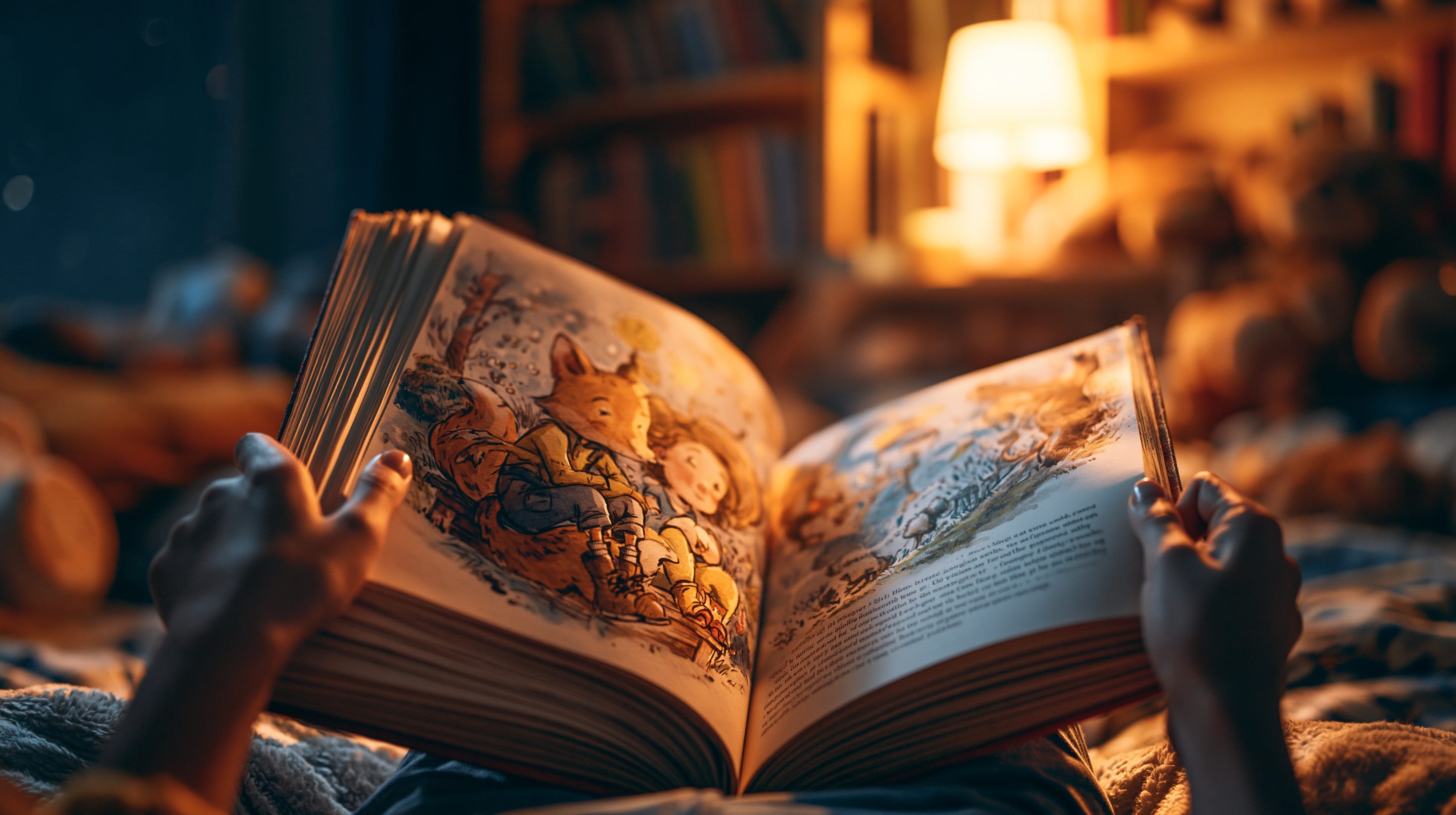
There is a particular kind of embarrassment that adult language learners carry around that nobody really talks about.
It is the embarrassment of the reading level.
You are a grown adult. You have a career, responsibilities, opinions, a rich inner life. You read sophisticated content in your native language. And yet here you are, considering picking up a book about a boy wizard or a series about haunted houses and cursed masks designed for ten year olds, and something in you feels like that is beneath you somehow. Like you should be reading Hemingway or The Economist or serious literary fiction. Like anything less is admitting defeat.
Let that embarrassment go. Right now. Completely.
Because the readers who make the fastest progress are not always the ones tackling the most challenging content. They are the ones reading the content that pulls them in, keeps them turning pages, and makes them want to come back tomorrow. And sometimes, often in fact, that content has a dragon on the cover and was technically written for a twelve year old.
That is absolutely fine. More than fine. It might be exactly what you need.
What Makes a Good English Reader Great
Before we talk about specific books, let’s be clear about what actually makes reading effective for language acquisition.
It is not the complexity of the vocabulary. It is not the sophistication of the themes. It is not the literary prestige of the author or the fact that the book appears on university reading lists.
What makes reading effective for language acquisition is engagement. Are you genuinely interested in what is happening on the page? Are you reading to find out what happens next? Are you so absorbed in the story that the English is becoming almost transparent, a window through which you are experiencing the narrative rather than a code you are laboriously decoding?
That state of absorption, where you forget you are reading in a second language because you are too busy caring about the story, is the optimal state for language acquisition. Your affective filter is low. Your attention is on meaning. The vocabulary and grammar are being processed deeply because they are attached to things you actually care about: characters you like, plots you’re invested in, worlds you want to spend time in.
A beginner who is completely absorbed in a Goosebumps book is acquiring more English per hour than an intermediate learner dutifully grinding through a dense academic text they find deeply boring. Engagement is not a nice addition to effective reading. It is the whole thing.
The Case for Children’s and Young Adult Literature
Children’s and young adult literature has some specific qualities that make it genuinely excellent for language learners, quite apart from the engagement factor.
The vocabulary is real and natural but not obscure. Children’s books are written to be understood by young readers, which means the language is clear, direct, and relatively free of the kind of rare, specialised vocabulary that can make adult literary fiction slow going for a learner. But it is still real English, not simplified or dumbed down in the way that some graded readers can feel. The sentences are natural. The dialogue sounds like people actually talk. The descriptions are vivid and concrete.
The grammar is standard and correct. You are reading properly written English. Every sentence is a model of how English actually works. Every page is full of the kind of correct, natural constructions that your brain needs to absorb in order to develop its feel for the language.
The stories are genuinely compelling. This might sound like faint praise but it is actually crucial. The authors who write for children and young adults are, in many cases, extraordinary storytellers. They have to be. Young readers are ruthless. They stop reading the moment they are bored, which means the books that succeed in that market are the ones that are genuinely, relentlessly engaging. That engagement works just as powerfully on adult learners as it does on young readers.
And they are often part of long series. This is a hidden gem for language learners. Reading a long series means spending extended time in the same world, with the same characters, and often with the same recurring vocabulary and phrasing. The language of that world becomes deeply familiar. Words and expressions that were new in book one are old friends by book three. The repetition across a long series is one of the best natural vocabulary consolidation tools available.
Harry Potter: The Language Learner’s Secret Weapon
Let’s talk about the most famous example, because it deserves its own discussion.
Harry Potter is arguably one of the best series a language learner can read, and not just at the beginner level. The early books, particularly The Philosopher’s Stone and The Chamber of Secrets, are written at a level that an intermediate English learner can engage with comfortably, while still being rich in natural, varied, beautifully written English.
As the series progresses, the books get longer, denser, and more complex, growing alongside the characters in a way that mirrors the language learner’s own progression. A learner who starts with The Philosopher’s Stone and reads through to The Deathly Hallows has read millions of words of high quality English across a huge range of vocabulary, from the simple and domestic to the complex and dramatic. They have done this while being completely absorbed in one of the most compelling narratives in modern fiction.
The audiobooks, narrated by Stephen Fry in the UK editions and Jim Dale in the US editions, are extraordinary. Both are master narrators with perfect diction, natural rhythm, and an extraordinary range of character voices. Reading and listening simultaneously to Harry Potter, following the text while hearing it read aloud by one of these voices, is one of the richest combined input experiences available to an English learner at any level.
If you want a specific British accent model, Stephen Fry’s narration is essentially a masterclass in elegant, warm, characterful British English. Hundreds of hours of it, across seven books. For a learner targeting a British accent or simply wanting to absorb the sound and rhythm of beautiful spoken English, it is close to perfect.
R.L. Stine and the Power of Pure Readability
At the other end of the spectrum from Harry Potter sits R.L. Stine’s Goosebumps series, and it deserves just as much respect as a language learning tool.
Goosebumps books are short. They are fast. They are written in clean, simple, propulsive English that moves at pace and keeps you reading. The vocabulary is accessible, the sentences are clear, and the plots, for all their simplicity, are genuinely entertaining in a campy, spooky, enjoyable way.
For a learner who is not yet ready for the sustained complexity of Harry Potter, Goosebumps is a fantastic entry point. Finishing a Goosebumps book in an afternoon gives a learner something psychologically valuable: the experience of completing an English book. Of reading something from cover to cover in English and understanding it. Of building confidence in their reading ability in a way that struggling through something too difficult never can.
That confidence is not trivial. It feeds the habit. A learner who has finished ten Goosebumps books knows they can read in English. And that knowledge makes picking up the next book, slightly harder than the last, feel achievable rather than daunting.
Other Series Worth Considering
Harry Potter and Goosebumps are just the most famous examples of a rich and varied landscape of children’s and young adult literature that works brilliantly for English learners. Here are some others worth considering depending on your level and your tastes.
Diary of a Wimpy Kid by Jeff Kinney is written partly in diary format with illustrations, which makes it very accessible for beginners. The language is colloquial, contemporary, and genuinely funny. It captures the way young people actually speak and write in a way that gives you a great feel for informal, natural English.
The Chronicles of Narnia by C.S. Lewis is beautiful, imaginative, and written in wonderfully clear, elegant prose. Lewis was a master of explaining complex ideas simply, and his writing has a warmth and clarity that makes it both enjoyable and linguistically rich.
The Hunger Games by Suzanne Collins sits at the young adult end of the spectrum and is written in a compelling, fast-paced first person voice. The vocabulary is more sophisticated than the earlier examples here, making it ideal for intermediate learners who want something genuinely gripping.
Percy Jackson and the Olympians by Rick Riordan is funny, fast, and written in a very natural, contemporary American English voice. The humour is genuine and the storytelling is relentless. For learners interested in American English specifically, it is excellent.
The Roald Dahl catalogue, while technically aimed at younger readers, contains some of the most distinctive and inventive English prose written in the twentieth century. Dahl’s vocabulary is rich, playful, and unlike anyone else. Reading him gives you something genuinely unusual and memorable to absorb.
What About Audiobooks?
Every book on this list has an audiobook version, and for most of them the audiobook is excellent. Combined reading and listening, following the text while listening to the audio, is as powerful for children’s literature as it is for any other content.
For Harry Potter specifically, as mentioned above, the audiobooks are exceptional. But the Hunger Games audiobook, the Percy Jackson audiobook, the Roald Dahl audiobooks: all of these are professionally produced, beautifully read, and incredibly useful for combining reading comprehension with pronunciation and rhythm modelling.
If you are using LingQ, many of these texts can be imported and engaged with in the read-and-listen format with vocabulary support built in. Sign up here and start building your reading habit with content you actually love: lingq.com
The Progression
One of the most natural and satisfying things about starting with accessible literature is the way it creates its own progression.
You start with Goosebumps. You build confidence and vocabulary. You move to Diary of a Wimpy Kid. You enjoy it and pick up more natural, colloquial English. You try the first Harry Potter and find it manageable. You read the whole series and by the end you are reading at a level that would have felt completely out of reach when you started.
Then you pick up something aimed at adults, a thriller perhaps, or a popular non-fiction book, and you find it much more accessible than you expected. Because all that reading has built something real. Your vocabulary is broader. Your feel for natural English is deeper. Your reading speed is higher. Your confidence is unshakeable.
That progression, from children’s books to young adult to adult literature, is not a compromise. It is the most natural, most enjoyable, most effective reading journey an English learner can take. It mirrors exactly the journey a native English speaker takes from childhood to adulthood. And it works for the same reason: the books at every stage are genuinely enjoyable, and enjoyment is what keeps you reading, and reading is what builds the English.
A Final Word on Embarrassment
If you still feel a small twinge of embarrassment about picking up a book with a cartoon cover or a story about children fighting monsters, here is a thought worth sitting with.
Nobody needs to know what you’re reading. And even if they did: the person who has read ten Harry Potter books in English, absorbed millions of words of natural, rich, beautifully written English, built a vast passive vocabulary, and developed a genuine love of reading in English, that person is miles ahead of the person who bought an advanced grammar textbook and gave up after three chapters because it was so boring.
The goal is fluency. The path is reading. The only condition is that you actually do it.
Pick up whatever makes you want to read. And then read.
Let’s Talk About What You’ve Been Reading
For graduating from children’s books to real English content at your own pace, with instant vocabulary lookup and tracking that shows every step of the journey, LingQ is the tool I recommend above all others: lingq.com
For the visual equivalent of children’s books, real TV shows and films with interactive subtitles that support you at every level, Lingopie turns your screen time into genuine acquisition.
If you want compelling, story-driven English listening at just the right level, Olly Richards’ Conversations course is well worth exploring.
If you’re looking for a conversation partner who will never judge where you started, only celebrate how far you’ve come, iTalki is where I’d start. And if you’d like to work with me specifically, book a trial lesson here.
✍🏼 Richard
Some links on this blog are affiliate links. I earn a small commission if you sign up, at no cost to you. I recommend these products because I genuinely believe in them.
Disclosure: LingQ links on this blog are affiliate links. I earn a small commission if you sign up, at no cost to you. I recommend LingQ because I genuinely believe in it.