

Most English learners I meet don’t need more information. They need a routine they can keep.
There are so many apps, courses and grammar books out there. It’s easy to spend more time choosing what to do than doing it.
So this is the routine I recommend to my students. It fits around work and family, and it doesn’t need a classroom. It’s built on listening you enjoy and speaking practice you repeat until it sticks.
Find a Podcast You Love
Everything starts with listening. Stephen Krashen showed that we acquire a language by understanding messages in it. Grammar rules and word lists come a distant second.
So your first job is to find something you want to listen to. Pick a podcast about a topic you would enjoy in your own language. Football, business, history, cooking, true crime, travel. It doesn’t matter what it is, as long as you look forward to the next episode.
The level is important too. You should understand most of what you hear, even if some words slip past you. If it feels like noise, start with a podcast made for English learners. You can move to native shows once your ear gets stronger.
Try a few. Give each one a couple of episodes. When you find one that you keep coming back to, you’ve found your podcast.
Download a few episodes so you always have something ready, even without wifi. Then there’s no reason to skip a day.
Listen as Much as You Can
Once you have your podcast, the goal is simple. Listen a lot.
You don’t need to sit at a desk to do this. Listen on the bus, in the car, at the gym, while you cook, while you clean, while you walk the dog. These are hours you already have. Now they become English hours.
Thirty minutes on the way to work adds up to more than 180 hours of English in a year. That is more listening than most people get in years of classes.
Listening to the same episode twice is fine. In fact it’s a good idea. The second time, you catch words you missed and hear how phrases fit together. Your brain is doing the work even when it feels easy.
Some listening will be focused and some will be in the background. Both help. Focused listening builds understanding. Background listening keeps the sound of English in your ear all day.
Practise Speaking With Flexling
Listening builds your understanding. But many learners tell me the same thing. “I understand a lot, but when I try to speak, the words don’t come.”
This is where Flexling helps a lot. It’s the app I now recommend to all my students for speaking practice.
It works like this. You hear each sentence first in your mother tongue, so the meaning is clear. Then you hear it in English, once, twice or as many times as you choose. You repeat it out loud.
That’s it. Simple, and very effective when you do a lot of it.
Huge Amounts of Repetition
The secret with Flexling is volume. A few sentences here and there won’t change much. Hundreds of sentences a day, every day, will.
Fluent speakers don’t build sentences from rules while they talk. They pull ready made patterns from memory. “I was going to,” “Do you mind if,” “It depends on.” These come out automatically because they’ve been heard and said thousands of times.
Repetition on Flexling gives you those patterns. You say them so often that they move from your head into your mouth. Then, in a real conversation, they’re ready when you need them.
Because you always hear the meaning first, you never repeat words you don’t understand. Every sentence is clear, and every repetition counts.
Try to say each sentence out loud, not in your head. Copy the rhythm and the stress, not just the words. Don’t worry about sounding perfect. Your pronunciation will improve as you go.
Aim for at least 20 minutes a day. If you can do more, do more. Two short sessions, one in the morning and one in the evening, work well for a lot of people.
Add Some Reading
Reading is the third part of the routine. It builds vocabulary faster than listening alone, because you can see each word and take your time with it.
Read whatever you enjoy. News, short stories, blogs, books on a hobby. Graded readers are a great start if novels still feel too hard.
LingQ is a good tool for this. You can read with audio, look up new words quickly and save them to review later. You can also import your own articles, so you’re always reading something you care about.
Even 15 minutes a day makes a difference. Read on your lunch break or before bed.
Chat When You Get the Chance
Conversation is the icing on the cake. If you have the chance to speak with a native speaker or a tutor, take it.
Flexling already covers a lot of the speaking practice, so you don’t need daily lessons. One or two conversations a week is plenty for most people. It gives you a place to use the patterns you’ve been practising and builds your confidence.
If you’d like a regular speaking partner, you can find tutors on iTalki. I teach there too, and you can book a lesson with me through my iTalki profile. My lessons are relaxed and conversational, with plenty of room to make mistakes.
A Day in Practice
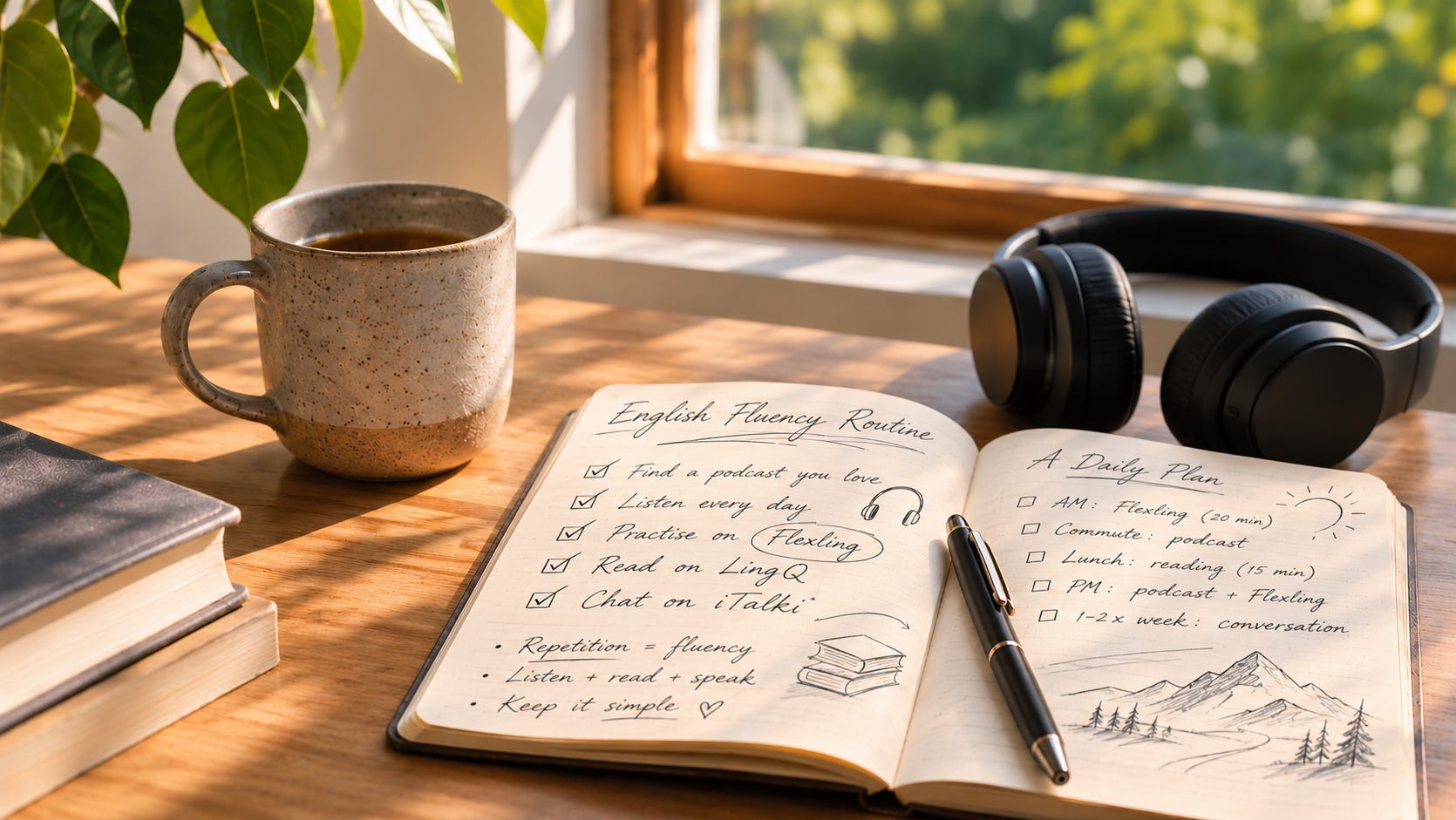
Here is how this routine might look on a normal working day:
In the morning, 20 minutes of Flexling with your coffee
On your commute, your podcast
At lunch, 15 minutes of reading on LingQ
In the evening, your podcast while you cook, then another round of Flexling
Once or twice a week, a conversation lesson
You don’t need to follow this exactly. Move things around to fit your life. Some days you’ll do more, some days less.
When Progress Feels Slow
There will be weeks when nothing seems to change. You listen every day, you repeat your sentences, and English still feels hard.
This is normal. Acquisition happens below the surface. Your brain is sorting sounds, words and patterns long before you can use them.
Most learners notice progress looking back rather than day to day. So keep a simple record. Write down the episodes you finish and how many Flexling sentences you do each day. After a month, look back at it. You’ll be surprised how much you’ve done.
Another good test is to listen to an old episode. Pick one from your first week. You’ll often find it’s much easier to follow than you remember.
Notice the small wins too. Catching a joke. Following a whole story without translating in your head. Saying a phrase in a lesson before you even think about it. These are signs the routine is working.
Keep It Light
The best routine is the one you still follow in six months. So keep it enjoyable.
If you get bored of your podcast, change it. If you miss a day, start again tomorrow. Don’t try to be perfect, and don’t turn this into homework.
Grammar can wait. A little grammar study is like seasoning on food. It adds something, but it isn’t the meal. Listening, repetition and reading are the meal.
Stick with it for a few months and you’ll notice the change. English will start to feel familiar. Sentences will come out more easily. And you’ll wonder why you ever spent so long on grammar exercises.
Got a question about learning English? Send it my way and I might answer it in a future post.
If this was useful, give it a like or restack it so other learners can find it.
Richard, English teacher in Auckland, helping you build English fluency without studying grammar
Tools I Recommend
Flexling for daily speaking practice through sentence repetition
LingQ for reading with audio and building vocabulary
iTalki for finding a tutor and regular conversation practice
My English lessons on iTalki for relaxed, conversational classes with me
Some of the links in this post are affiliate links. If you sign up through them, I may earn a small commission at no extra cost to you. I only recommend tools I use and believe in.
I woud love to see this post not limited to English. We have hundreds of languages all over the globe. English is actually “only” on the 3rd place of native languages 😉
Great tips! I also like watching a daily TV show in the language I'm learning. It helps me get used to the way people actually speak and pick up new expressions along the way.